
Calendar Watch: Why a Bot Manages My Meeting Schedule
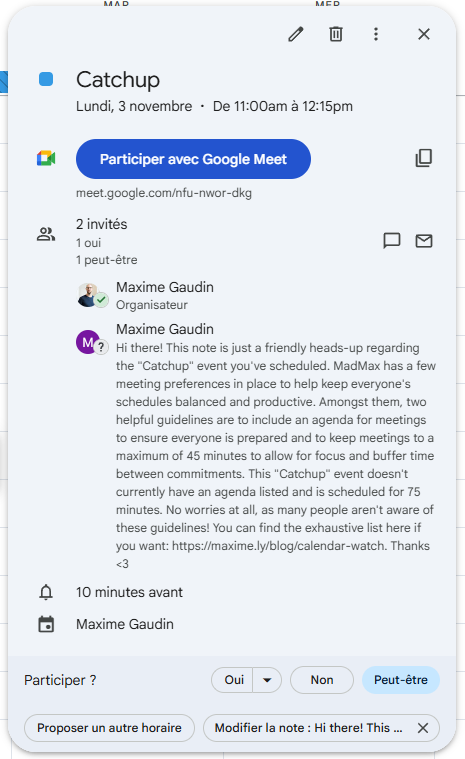
If you're reading this article, chances are you just received an automated response from my Calendar Watch bot declining or questioning your meeting invitation. Before you think I'm being difficult—let me explain why a robot guards my calendar, and why this might actually make our meeting better.
TL;DR: The Rules
Want to get a meeting accepted? Make sure it follows ALL these criteria:
- Maximum 45 minutes - No hour-long meetings. Keep it concise.
- Between 9 AM and 5 PM - Respect peak productivity hours.
- Weekdays only - No weekend meetings, period.
- Maximum 5 participants - Keep it small and focused.
- Must have an agenda - Clear purpose, expected outcomes, and preparation requirements.
These aren't personal preferences—they're automated standards that save companies millions in wasted meeting costs while improving meeting quality for everyone.
A Note on Kindness
If you've received a Calendar Watch response, please know that it's not personal. The whole point of automating this process is to remove personal judgment and social friction.
The bot isn't annoyed with you. It's not being passive-aggressive. It's simply enforcing standards that help me (and hopefully you) have better, more productive meetings.
Think of it like an automated spell-checker—it's not judging your intelligence; it's catching issues before they become problems.
Calendar Watch treats everyone identically—whether you're the CEO or an intern, you get the same automated feedback if the meeting doesn't meet the criteria.
What About Exceptions?
I'm not a robot (even if my calendar is managed by one). I understand that sometimes there are exceptional circumstances:
- A critical customer escalation that needs immediate attention
- A strategic decision that requires more than 5 people
- An urgent situation that falls outside standard hours
In those cases, I'll make exceptions. The bot might flag the meeting, but I'll override it when it makes sense.
The key difference is that exceptions are intentional. They happen because the situation truly warrants breaking the rules, not because we're defaulting to bad meeting hygiene.
The Rationale: Why These Rules Exist
The following sections explain the thinking behind Calendar Watch. Feel free to skip if you just needed the rules above.
The Calendar Asymmetry Problem
Here's something that bothers me deeply about modern work culture: There's a massive asymmetry in how meetings work.
Creating a meeting is effortless. A few clicks, and boom—you've blocked 30 minutes (or worse, an hour) of someone else's time. But declining that meeting? That's considered rude. It can even trigger questioning about your professionalism or commitment!
This creates a terrible dynamic where:
- It's easy to demand someone's time
- It's socially awkward to refuse
- The burden falls entirely on the recipient
And don't get me started on the classic move: someone casually drops a 30-minute meeting on your calendar, which then generates hours of preparation or follow-up work on your end.
I am not okay with this system.
Why I Don't Block My Calendar
The typical solution people suggest is to block out "focus time" or "do not disturb" slots in your calendar. But I find this approach frustrating for several reasons:
I don't know in advance when I'll need focus time. Some days I'm energized and can handle back-to-back meetings. Other days, I need long stretches of uninterrupted work.
It feels defensive. Why should I have to preemptively protect my time when the real problem is that meetings are created without proper consideration?
It doesn't address the root issue: Poorly planned meetings that shouldn't exist in the first place.
So instead of playing calendar Tetris, I decided to tackle the problem at its source: the quality of meeting invitations themselves.
Enter Calendar Watch
Calendar Watch is an automated tool that scans every meeting invitation I receive. It checks that certain standards are met, and if they're not, it automatically responds with an explanation in my RSVP.
And yes, it's truly automated. I'm not personally writing these responses. The bot treats everyone identically—whether you're the CEO or an intern, you get the same automated feedback if the meeting doesn't meet the criteria.
This approach does two things:
- It ensures I only attend well-planned, valuable meetings
- It removes the social awkwardness—it's not me rejecting you; it's an automated system enforcing standards
The Rules Explained: What Calendar Watch Checks
The rules are actually quite simple. A meeting must satisfy ALL of the following criteria:
Rule 1: Maximum 45 Minutes
Meetings should not exceed 45 minutes. Period.
Why? Because most meetings don't need an hour. The default 60-minute block is a relic from when calendars were paper and granular timing was hard. In reality, most discussions can be resolved in 30-45 minutes if they're well-structured.
Plus, the 15-minute buffer between meetings gives everyone time to breathe, take notes, or mentally transition to the next topic.
Rule 2: Between 9 AM and 5 PM
All meetings must fall between 9:00 AM and 5:00 PM.
You might wonder: "Why so early? Most people work until 6 or 7 PM."
Here's the thing—I have significantly less energy in the late afternoon. Meetings require a lot of mental bandwidth: active listening, quick thinking, decision-making. I'm simply not at my best after 5 PM.
More importantly, I've discovered that the beginning and end of my workday are critical for my productivity. Early morningsid when I do my best deep work. End of day is where I consolidate my notes and setup the next day. I'm not willing to sacrifice those golden hours for a meeting that could've been scheduled earlier.
Rule 3: Weekdays Only
It's probably obvious but meetings should only be scheduled Monday through Friday.
If something is truly urgent enough to require weekend work, it deserves a direct conversation, not a calendar block.
Rule 4: Maximum 5 Participants
A meeting should never have more than 5 participants.
Why? Because beyond 5 people, there are inevitably attendees who:
- Don't need to be there
- Won't actively contribute
- Could simply read the meeting notes afterward
The effectiveness of a meeting is almost inversely proportional to the number of attendees.
Large meetings turn into presentations or political theater. Small meetings drive decisions and get work done.
Rule 5: Must Have an Agenda
Every meeting must include an agenda or clear purpose.
This rule is violated constantly, but it's a hard "no" for me. Before accepting any meeting, I need to understand:
- What is the purpose of this meeting?
- What is expected of me?
- What should I prepare?
- Why is each person attending?
Without an agenda, meetings devolve into unfocused discussions that waste everyone's time. Even worse, they often lead to backstabbing or tangential conversations because there's no clear goal to anchor the discussion.
A meeting without an agenda is a meeting that shouldn't happen.
Why This Matters
These rules might seem strict, but they serve a crucial purpose: they force intentionality.
When someone has to consider these criteria before inviting me to a meeting, they naturally ask themselves:
- Does this really need to be a meeting?
- Could this be an email or a Slack message instead?
- Who actually needs to attend?
- What do we need to accomplish?
In other words, Calendar Watch doesn't just protect my time—it improves the quality of meetings for everyone involved.
The Business Case: A Major Cost Saver
Beyond personal productivity, enforcing these meeting standards can generate substantial cost savings for organizations. The numbers are striking:
Shopify's Meeting Cost Calculator revealed that a single 30-minute meeting with three employees can cost between $700 and $1,600 when you factor in salaries and opportunity costs. By eliminating just three such meetings per week per person, they estimated a 15% reduction in overall meeting costs. (Source)
A tech company studied by Worklytics implemented calendar analytics to optimize their meeting culture. Over 12 weeks, they:
- Reduced average meetings per week from 27 to 23
- Increased focus time blocks by 133%
- Saved an estimated $8.2 million annually
(Source)
Even smaller optimizations compound quickly. MeetingCalc found that simply changing weekly status meetings to biweekly for a division of 120 employees saved $17,290 annually and reclaimed 364 hours of productive time. (Source)
Another example: shortening a weekly executive team meeting from 90 to 60 minutes led to annual savings of $39,375—a 33% reduction. (Source)
The math is simple: Every poorly planned meeting doesn't just waste time—it actively costs money. When you enforce standards like:
- 45-minute maximum (vs. the default 60 minutes)
- Maximum 5 participants (vs. large group meetings)
- Required agendas (preventing unnecessary meetings altogether)
You're not just being picky about your calendar. You're actively saving the company money.
Think about it: if Calendar Watch prevents just one unnecessary hour-long meeting with 5 people per week, and the average salary is $100k, that's roughly $240 saved per week, or $12,500 annually—per person applying these rules.
Scale that across a team or organization, and you're looking at hundreds of thousands to millions in recovered productivity costs.
The Bigger Picture
At the end of the day, Calendar Watch is my response to a broken system. Meetings have become the default solution for everything, often without considering whether they're the right tool for the job.
By establishing clear standards and automating their enforcement, I'm able to:
- Maintain my productivity and energy levels
- Ensure the meetings I do attend are well-planned and valuable
- Remove the social awkwardness of declining meetings
- Encourage better meeting practices across the board
It's not about being difficult. It's about being intentional.
If this article resonates with you, consider what rules you might want to establish for your own calendar. You don't need to build a bot (though you could). Sometimes just having clear criteria and communicating them is enough.
Your time is valuable. Protect it accordingly.
Disclaimer: The views and opinions expressed in this article are my own and do not necessarily reflect the official policy or position of my employer. Any content provided is not intended to malign any organization, company, or individual.